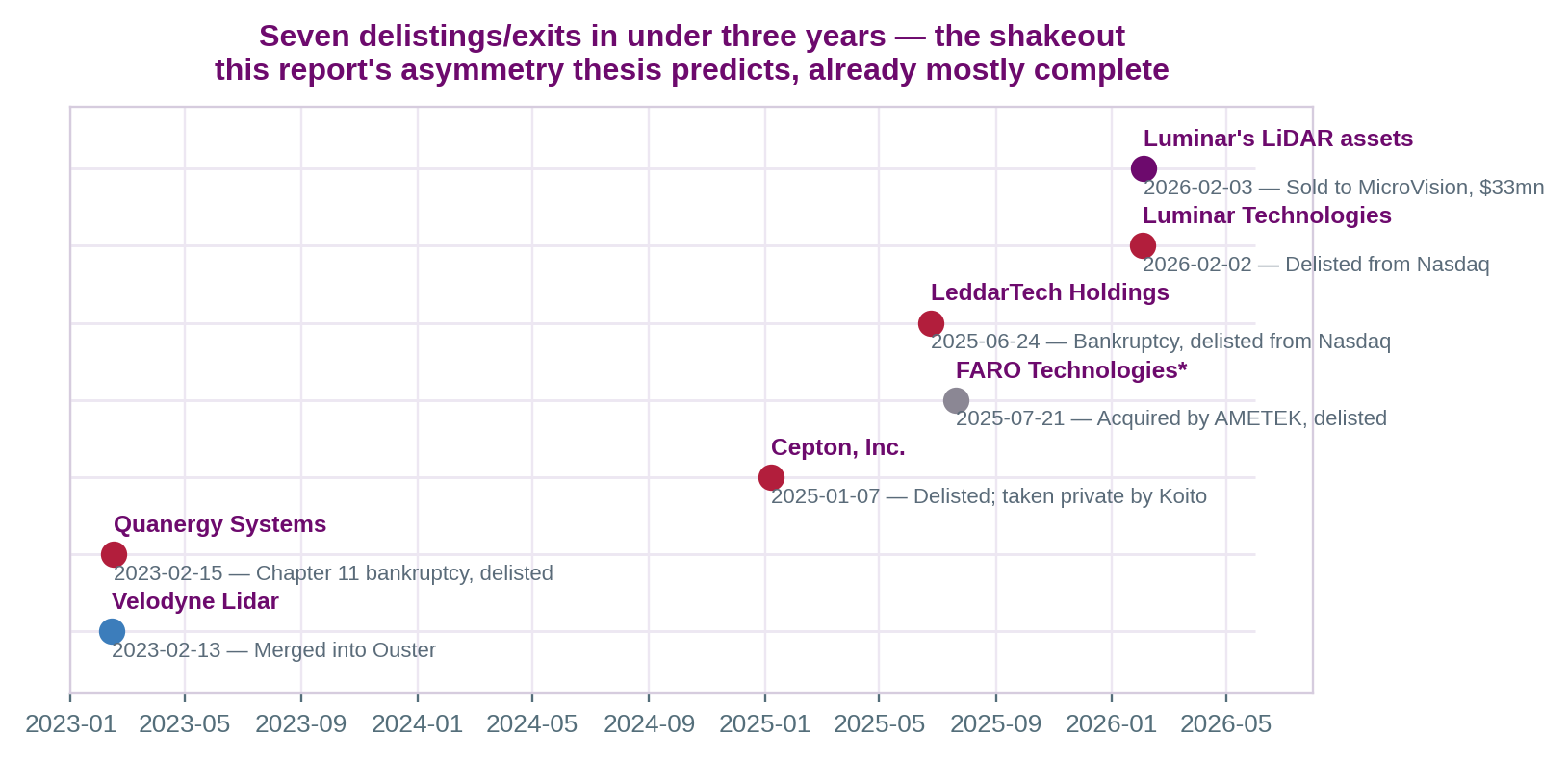
Six US-exchange-listed companies remain as this report's pure-play LiDAR coverage universe — Ouster, Hesai, Aeva, Innoviz, AEye and MicroVision — and every one of them is a survivor of the shakeout described throughout this report, not a company untouched by it. Between February 2023 and February 2026, seven LiDAR or closely-adjacent companies were delisted, went bankrupt, or were acquired: Velodyne (merged into Ouster), Quanergy (bankrupt), Cepton (taken private by Koito), LeddarTech (bankrupt), FARO Technologies (acquired by AMETEK), and — most consequentially for this report's own coverage — Luminar Technologies, once the most prominently marketed Western LiDAR company, delisted from Nasdaq in January-February 2026 with its core LiDAR assets sold to one of this report's own six companies, MicroVision, for $33 million.
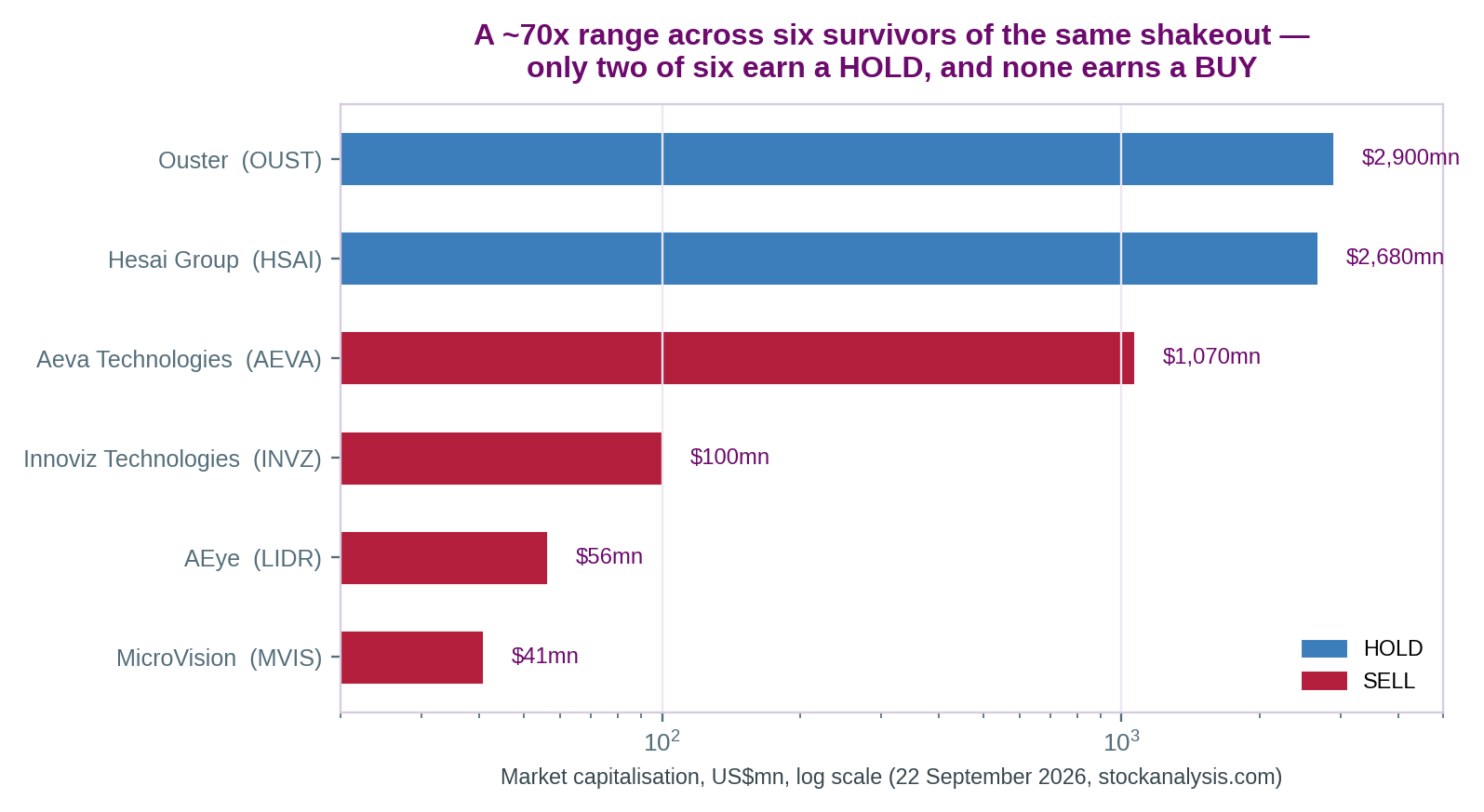
Every company profiled here would describe its own technology as differentiated, and on the evidence in this research, each genuinely has a real claim to some differentiation — Aeva's FMCW coherent detection, Innoviz's deep OEM design-win relationships, AEye's software-defined adaptive scanning, MicroVision's multi-architecture breadth. But this report's own research found that financial health, not technology story, is what currently separates these six companies, and the split is stark:
| Tier | Companies | What defines the tier |
|---|---|---|
| 1 — Profitable or well-capitalised | Hesai (5 consecutive profitable quarters, net-cash balance sheet); Ouster (~$261mn liquidity, no debt, 56% YoY revenue growth) | Real, disclosed earnings or a balance sheet that can fund the current strategy without near-term rescue financing |
| 2 — Well-funded, but pre-scale economics | Aeva ($302.9mn total liquidity, but a ~45.8x EV/Sales multiple on $21.6mn TTM revenue and an unproven August 2026 strategic pivot) | Cash is not the constraint; the valuation already prices in years of flawless execution the disclosed numbers do not yet support |
| 3 — Distress-level risk | Innoviz (Nasdaq compliance grace period expired 21 Sep 2026, outcome unconfirmed); AEye (pre-revenue, no confirmed automotive OEM win, active $200mn dilution shelf); MicroVision (explicit, disclosed going-concern warning) | A near-term, company-specific financial or listing event that could move the stock independent of the underlying technology story |
Source: Dart Consultants, from each company's own report in Part 4 of this document.
Every one of the five companies that exited this industry since 2023 had genuine, sometimes industry-leading technology — Velodyne invented the spinning-LiDAR category; Luminar held the industry's most prominent automotive design win with Volvo before losing it. None of that technology leadership converted into surviving as an independent public company. What did survive and scale is Hesai's combination of manufacturing cost discipline and shipped volume — the "volume beats invention" margin lesson stated in §2-3. Every rating in this section is really asking the same question this lesson poses: is this company's balance sheet built to survive long enough for its technology bet to reach that same kind of scale, or is it racing the clock?
| Company | Ticker | Exchange | Core technology bet | Market cap (22 Sep 2026) |
|---|---|---|---|---|
| Ouster, Inc. | OUST | Nasdaq | Digital ToF, 865nm — industrial/robotics-led | $2,900mn |
| Hesai Group | HSAI | Nasdaq (ADS) | Mechanical/hybrid solid-state ToF — automotive/robotaxi volume leader | $2,680mn |
| Aeva Technologies, Inc. | AEVA | Nasdaq | FMCW ("4D") LiDAR-on-chip | $1,070mn |
| Innoviz Technologies Ltd | INVZ | Nasdaq | 905nm solid-state ToF — deep OEM design wins | $100.15mn |
| AEye, Inc. | LIDR | Nasdaq | 1550nm software-defined adaptive scanning | $56.48mn |
| MicroVision, Inc. | MVIS | Nasdaq | MEMS + acquired ToF (ex-Luminar) + forthcoming FMCW | $40.92mn |
Sorted by market capitalisation. Source: stockanalysis.com, as of 22 September 2026 — see each company's own report in Part 4 for the reconciled figure where sources disagreed.