Three reasons the hard half does not scale the way the easy half does.
A newly assembled LiDAR's easy-mode success criterion is a bench demo you run today. A detection-margin design's real success criterion is the absence of a missed detection in a combination of range, weather and target reflectivity that may not occur again for months — a pedestrian in dark clothing, at 150 metres, in light rain, at dusk. You cannot inspect your way to confidence here; only extensive, statistically-designed field testing across weather and lighting conditions tells you whether the engineering margin was actually sufficient, and even then a rare-enough combination can still surprise you after deployment.
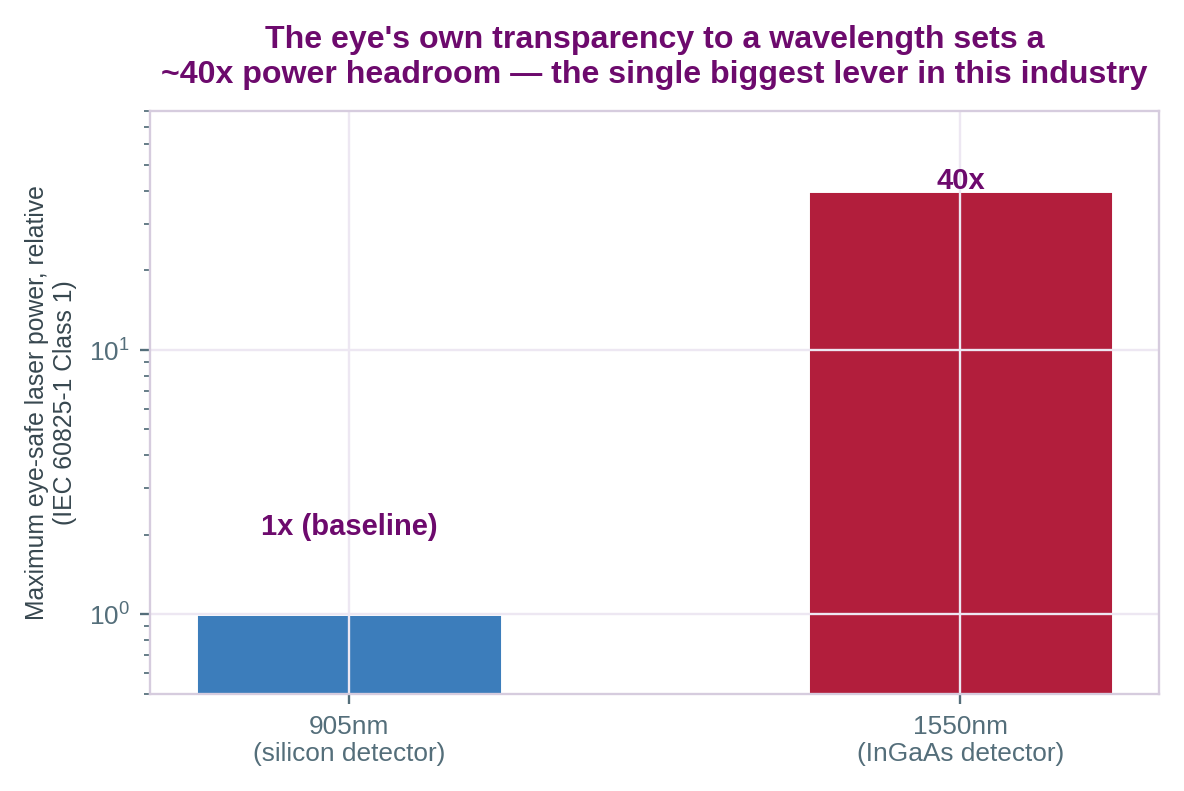
Unlike most engineering trade-offs, the maximum laser power a company is legally and ethically allowed to emit is not something better engineering can move — IEC 60825-1's Class 1 exposure limit is a hard physical/regulatory ceiling. A 905nm design is capped roughly 40x lower than a 1550nm design at the same safety rating (§1), which means every additional metre of range at 905nm has to come from a better receiver, better signal processing, or a more reflective assumption about the target — not from simply turning the laser up. This is why the wavelength decision in §1 cannot be revisited cheaply once a company has built years of manufacturing and supply-chain depth around one detector material.
ASIL certification and OEM design validation are not one-time badges. Every new vehicle platform an automaker launches typically requires its own validation cycle for a LiDAR supplier's part, even where the underlying sensor hardware is unchanged, and a hardware or firmware revision can trigger a fresh qualification round. There is no equivalent of "the same part just keeps shipping" in this industry the way there might be in a less safety-critical component category — each new platform relationship is close to a fresh multi-year qualification exercise, on a timetable the automaker, not the LiDAR supplier, controls.