The industry describes a LiDAR product two different ways, and the two descriptions do not always point to the same conclusion. The first is scanning-mechanism classification — mechanical spinning, MEMS-mirror solid-state, flash, or optical phased array (OPA) — which describes how the beam is steered across the scene. The second is detection-architecture classification (§1) — time-of-flight versus FMCW, and 905nm versus 1550nm — which describes what signal the sensor actually extracts and at what physical cost ceiling. A company can hold an impressive-sounding scanning mechanism and still be selling a commodity-grade, short-range part if its detection architecture has not cleared the automotive detection-margin bar in §2-3; conversely, a mechanically simple sensor built around the harder detection-architecture choice can command real automotive pricing power.
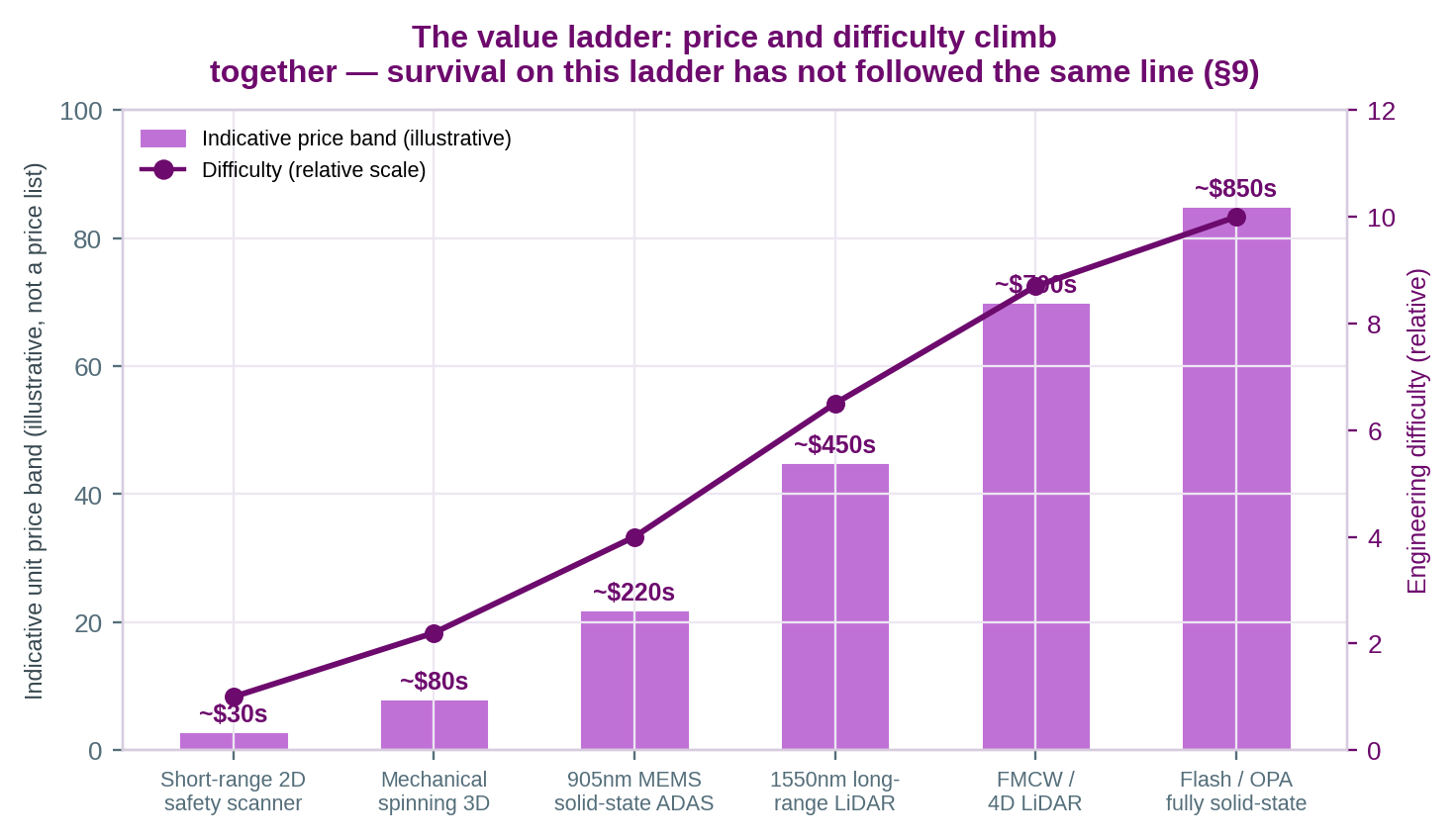
FMCW is the clearest case. On a simple scanning-mechanism reading, a solid-state FMCW unit looks similar to a solid-state ToF unit — both have no moving parts, both draw a point cloud. Yet the FMCW unit is doing categorically harder receiver engineering (coherent detection, narrow-linewidth laser sourcing) for a capability — instant per-point velocity, interference immunity — that a scanning-mechanism-only description completely misses. A reader who classifies LiDAR purely by "solid-state vs. mechanical" will systematically under-rate how differentiated an FMCW product actually is, and over-rate how differentiated a merely solid-state ToF one is next to a well-executed mechanical-spinning competitor. Keep this in mind through §9, where Aeva is this report's only FMCW pure-play.
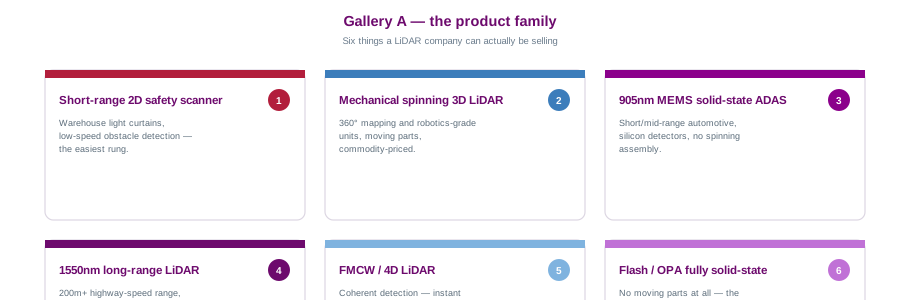
What a LiDAR company can actually be selling, arranged from commodity to engineered.
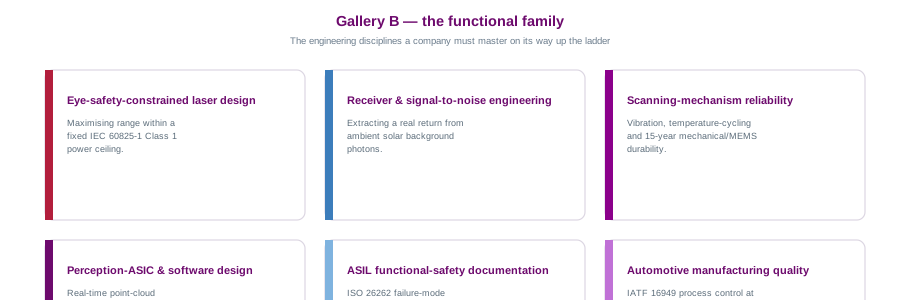
The engineering disciplines a company must actually master on its way up that ladder, whichever company happens to be holding the work at the time.