If automotive-grade detection is this demanding, why does any vehicle on the road today ship without a LiDAR at all? Because a camera-and-compute stack lets the software do the hard work instead of the sensor. A modern neural-network perception model can infer depth, velocity and object classification from ordinary 2D camera images alone — imperfectly, and with well-documented edge-case failures, but cheaply, using hardware every vehicle already carries for other reasons. This is the industry's own "free input": Tesla's public, repeated argument for its vision-only Autopilot/FSD architecture is precisely that sufficiently capable software can substitute for a sensor most competitors treat as mandatory, and it is why camera-and-radar-only ADAS remains commercially viable at the low end of the market even as LiDAR believers describe it as a hard safety requirement. The same substitution shows up in mapping: multi-image photogrammetry can approximate a 3D point cloud from ordinary photographs, without any laser at all, for applications that do not need a certified, all-weather safety-grade measurement.
This is exactly why a commodity-grade, 905nm, time-of-flight sensor still finds a real market: for short-range, lower-speed, non-safety-critical use cases — a warehouse AMR, a robot lawnmower, a low-speed ADAS parking-assist feature — the detection-margin problem in §2-3 barely applies, because the range, weather-robustness and failure consequence are all far smaller. The commodity and the automotive-grade ends of this industry are not the same product wearing different price tags; they are solving genuinely different, physics-scaled versions of the same measurement problem.
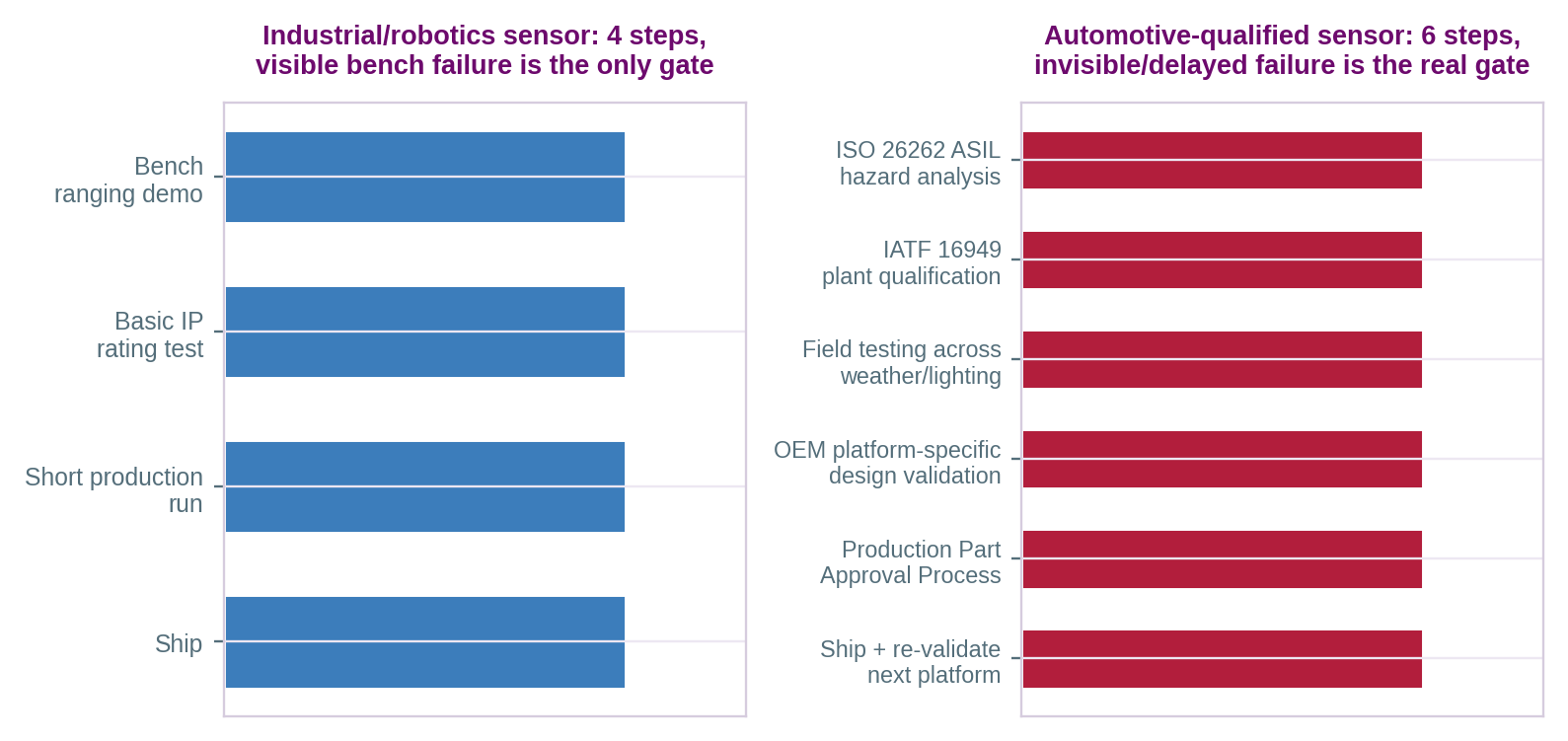
When a company report later in this document describes a company's sensor as "automotive-qualified" or "in production on an OEM platform," read that as: it has cleared the hard half described in §2-3, and its revenue quality should be judged accordingly. When it describes a company's shipments as concentrated in robotics, industrial or mapping use cases, read that as closer to the easy half — a real, growing market, but one with a much lower structural barrier to entry, and therefore a much larger and more price-competitive field of rivals, most of them Chinese and several of them unlisted.